---
title: Search
description: The static BM25 search index and client API that are on by default for SSG builds.
---
# Search
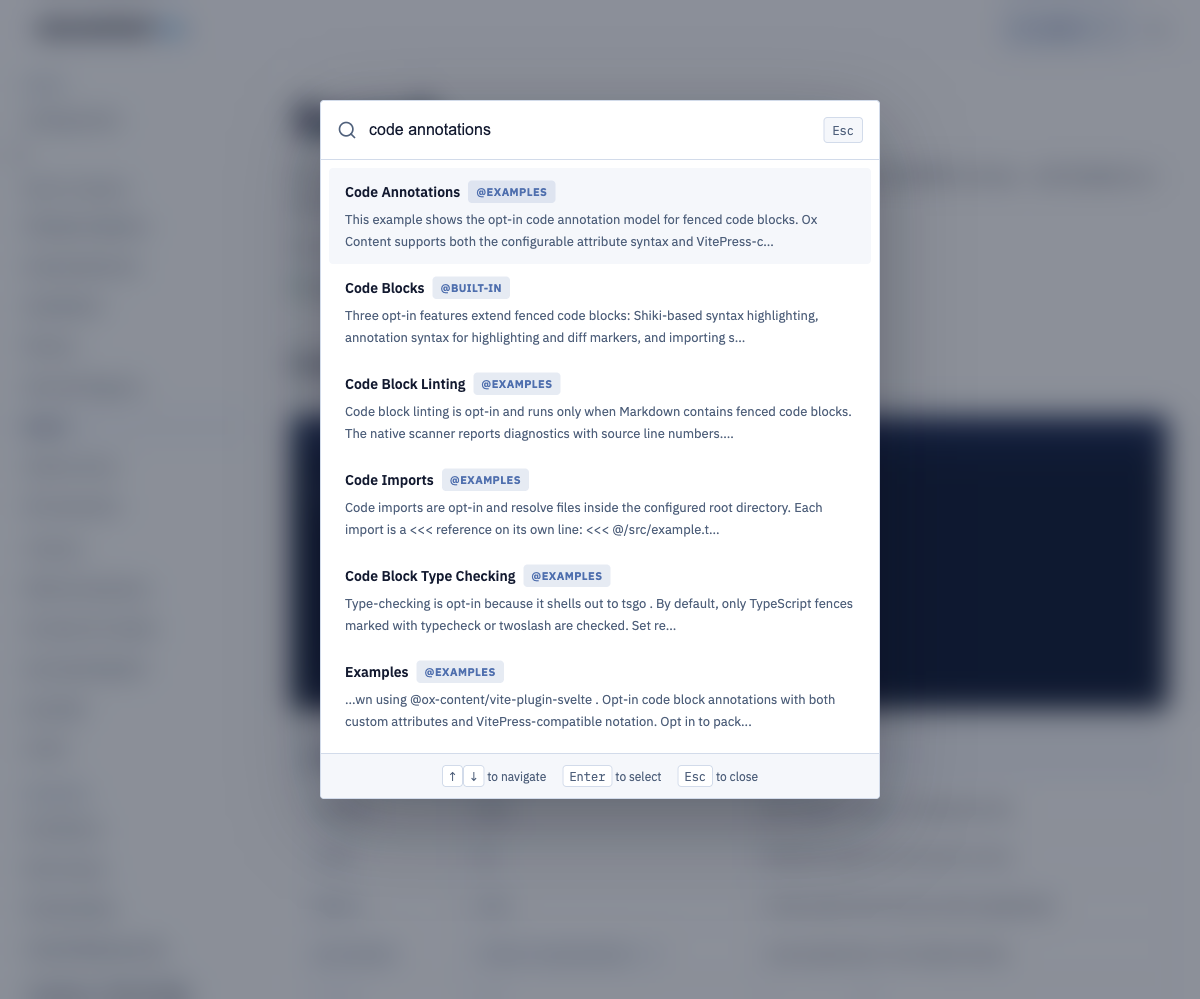
Full-text search is enabled by default. The index is built during the build —
in Rust, with BM25 scoring — and shipped as a static JSON file, so search
works on any static host with no server component.
Try it on this site: press / or ⌘K , or click the search
box in the header.
## Configuration
```ts
import { oxContent } from "@ox-content/vite-plugin";
export default {
plugins: [
oxContent({
search: {
limit: 8,
hotkey: "/",
placeholder: "Search documentation...",
},
}),
],
};
```
| Option | Default | Purpose |
| ------------- | --------------------------- | ---------------------------------------------- |
| `enabled` | `true` | Set `search: false` to disable entirely. |
| `limit` | `10` | Maximum results returned by the client. |
| `prefix` | `true` | Prefix-match the last query token (typeahead). |
| `fuzzy` | `false` | Match small typos in local BM25 results. |
| `placeholder` | `"Search documentation..."` | Input placeholder in the default theme. |
| `hotkey` | `"/"` | Focus hotkey; `""` opts out of registration. |
| `provider` | `"local"` | `"local"` keeps BM25. `"hosted"` is opt-in. |
The index is written to `search-index.json` next to the generated pages and
fetched lazily the first time a reader searches. During dev it is served from
memory and rebuilt as pages change.
When the site has more than one locale, the dialog shows a **Language**
`` and defaults to the current page. **All languages** searches the
whole index. When documentation versions are enabled, a **Version** ``
loads that version's `search-index.json`. Both controls are native selects, so
Tab, arrows, typeahead, Space, and Enter work without extra widgets.
## Query grammar
The Rust BM25 engine and the generated `virtual:ox-content/search` runtime use
the same normalized query model. That model keeps the typed text separate from
refinements so the UI can show stable chips and the engine can explain ranking.
| Query | Meaning |
| ---------------- | ------------------------------------------------------- |
| `install cli` | Terms that score exact BM25 postings. |
| `"static index"` | Phrase that boosts documents containing the exact text. |
| `render*` | Explicit prefix, even when it is not the last token. |
| `@api` | Scope derived from document id or URL path segments. |
| `scope:api` | Filter spelling for the same scope refinement. |
| `lang:ja` | Locale filter. `language:` and `locale:` are aliases. |
| `version:2.90` | Version filter. `v:` is an alias. |
Unclosed quotes are parsed as phrases while the reader is typing, so the UI can
continue to render useful state during keyboard refinement and IME composition.
Hosted search receives `rawQuery` plus `parsedQuery` in the request body; local
search applies scope, locale, and version filters directly to static documents
where those values can be derived from paths.
## Hosted provider
Search stays on the local BM25 index unless `provider` is set to `"hosted"`.
A hosted adapter accepts an application id, index name, and a **public
search-only key** from config or environment variables. Do not pass a write
or admin key. Fields named `adminKey`, `writeKey`, or `apiKey` are rejected.
```ts
import { oxContent } from "@ox-content/vite-plugin";
export default {
plugins: [
oxContent({
search: {
provider: "hosted",
appId: process.env.OX_CONTENT_SEARCH_APP_ID,
indexName: process.env.OX_CONTENT_SEARCH_INDEX_NAME,
searchKey: process.env.OX_CONTENT_SEARCH_KEY,
endpoint: process.env.OX_CONTENT_SEARCH_ENDPOINT,
},
}),
],
};
```
| Option | Source | Purpose |
| ----------- | ---------------------------------------- | -------------------------------------- |
| `appId` | config or `OX_CONTENT_SEARCH_APP_ID` | Hosted application id. |
| `indexName` | config or `OX_CONTENT_SEARCH_INDEX_NAME` | Remote index name. |
| `searchKey` | config or `OX_CONTENT_SEARCH_KEY` | Public search-only key. |
| `publicKey` | config or `OX_CONTENT_SEARCH_PUBLIC_KEY` | Alias for `searchKey`. |
| `endpoint` | config or `OX_CONTENT_SEARCH_ENDPOINT` | HTTP URL that receives search queries. |
`publicKey` is an alias for `searchKey`. When `endpoint` is omitted, the
client posts to `/search`. The request is a JSON `POST` with `query`,
`rawQuery`, `parsedQuery`, `limit`, and `indexName`, plus `x-app-id`,
`x-index-name`, and `x-search-key` headers. The adapter maps `hits` (or
`results`) to the same `{ id, title, url, score, matches, snippet }` shape as
local search and preserves `metadata`, `ranking`, and `ariaLabel` when the
hosted provider returns them.
If hosted search is selected but `appId`, `indexName`, or a public search
key is missing, the client fails closed: `search()` returns an empty array
and does not call a broken endpoint. Secrets are not logged. The local
`search-index.json` path is unchanged.
Placeholder and hotkey still come from `searchOptions` for custom UIs.
## Client API
The default SSG theme wires the search UI for you. For custom UIs, the same
index is available to any client code through a virtual module:
```ts
import {
createSearchUiState,
parseSearchQuery,
search,
searchOptions,
} from "virtual:ox-content/search";
const results = await search("code annotations", { limit: 5 });
const query = parseSearchQuery('@api "static index" lang:ja');
const ui = createSearchUiState(query.raw, results);
for (const result of results) {
// { id, title, url, score, matches, snippet, metadata, ranking, ariaLabel }
console.log(result.title, result.url, result.snippet);
}
```
- `search(query, options?)` uses local BM25 or the hosted adapter, depending
on `provider`. `options.limit`, `options.prefix`, and `options.fuzzy`
override the configured defaults per call. `fuzzy` is local-only and stays
off by default so large static indexes keep the fastest exact/prefix path.
`options.locale` keeps results in one language when you also pass
`localeCodes` and `defaultLocale`. `versionPrefixes` are stripped from
document paths before the locale segment is read.
- `searchOptions` exposes the resolved
`{ enabled, limit, prefix, placeholder, hotkey, provider }` so a custom UI
can honor the site configuration.
- Scoped queries like `@api transform` restrict results to a section of the
site.
- Results keep the base fields and add card-ready `scopes`, `metadata`,
`ranking`, and `ariaLabel`. `metadata` includes section context, active
filters, and derived language/version values when available. `ranking.reasons`
contains stable strings such as `title term match: install` or
`body phrase match: static index`.
- `parseSearchQuery(query)` exposes the normalized terms, phrases, prefixes,
filters, and scopes. `createSearchUiState(query, results, options)` covers
`empty`, `loading`, `no-results`, `results`, and `composing` states, and
returns listbox-friendly card ids for `aria-activedescendant`.
- `formatSearchResultForCard(result, index)` converts local or hosted results
into a stable result-card view model with `role: "option"`, badges, and an
accessible label.
The generated local runtime has a unit-tested 36 KB byte budget. The PR
benchmark/output-size report should also include the built `search-index.json`
size for the docs corpus so payload growth is visible when content changes.
When search is disabled, the virtual module still resolves — `search()`
returns an empty array and `searchOptions.enabled` is `false` — so custom UIs
do not need conditional imports.
## Related
- [Site Generation](./site-generation.md) — the SSG build that hosts the
default search UI.
- [Theming](../theming.md)